
Executive Functioning Tutoring & Coaching
Some students are bright, capable, and genuinely trying—and still can’t seem to get it together.
Missed deadlines, incomplete assignments, last-minute panic, and a backpack full of papers that were supposed to be handed in weeks ago.
Executive functioning is the set of mental skills that lets a student decide what to do, start doing it, keep track of it, and finish it on time. When those skills are underdeveloped—which is especially common in students with ADHD, anxiety, and other learning differences—the result is not laziness or bad attitude. It is a student who genuinely cannot bridge the gap between intention and action without support. These challenges often go unrecognized until middle or high school, when the stakes get higher and the scaffolding disappears.
Our executive functioning tutors and coaches work one-on-one with students to build the specific skills and strategies that are missing—and to help students understand themselves well enough to manage independently over time.
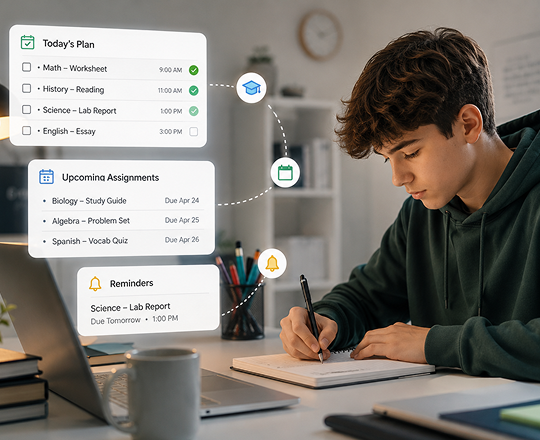
Executive functioning support for students with ADHD and dyslexia.
Students with ADHD often have the intelligence and motivation to succeed but face real obstacles with attention regulation, task initiation, and managing competing demands. Cognitive abilities that allow a person to plan, organize, prioritize, and manage time effectively are not fully developed until the mid-twenties; structured processes and scaffolding are required to bridge the gap.
Because reading, writing, and processing language often require more time and energy for students with dyslexia, their work takes them longer and they more quickly reach fatigue. This often leads to what looks like procrastination and frustration. Support focuses on building strengths while developing practical systems that make school more manageable.
Our tutors specialize in working with students with ADHD and dyslexia to build practical strategies that translate into day-to-day academic success.
You may be watching your child struggle and wondering why nothing seems to stick.
These are the signs we see most often:

Organizing Work
Difficulty starting tasks, which often appears as protesting

Completing Tasks
Starts but doesn’t finish, written work is poorly organized

Managing Time
Wastes time on small tasks, cannot allocate time accurately

Managing Materials
Doesn’t turn in completed work, cannot keep track of materials

Managing Attention
Skips steps, easily distracted
Some of the programs we use to help students develop these critical life skills are:

A research-backed system for students who need more than tips and reminders.
For a student who has never had a clear framework for how to approach their work, the Rush NeuroBehavioral Center’s executive functioning program provides exactly that. Developed by one of the country’s leading research institutions on executive function, it gives students practical tools for planning, prioritizing, and managing the emotional side of academic demands—not just strategies to try once, but a repeatable system they can rely on.

Building self-awareness that makes every other strategy work.
One of the most important shifts for a student with executive functioning challenges is moving from ‘I just can’t do this’ to ‘I know where I get stuck and what helps me.’ The SMARTS EF program is built around that insight. Rather than just giving students strategies to follow, it teaches them how to understand their own learning profile — so they can set meaningful goals, adapt when things are not working, and advocate for themselves in the classroom and beyond.
Dynamic Tutoring Solutions provides executive functioning coaching and tutoring for students throughout Chicago’s North Shore, including Lake Forest, Lake Bluff, Libertyville, Vernon Hills, Winnetka, Northfield, Glenview, Northbrook, Wilmette, Glencoe, Kenilworth, Evanston, and Highland Park. Our coaches work one-on-one with students to build organization, time management, planning, task initiation, study skills, and self-advocacy skills, with support tailored to students with ADHD, dyslexia, and other learning differences
-
What is executive functioning tutoring and coaching, and is there a difference?
Executive functioning tutoring and coaching both focus on helping students build the skills they need to manage their academic and daily lives — things like organization, time management, planning, task initiation, and follow-through. Tutoring tends to be more directly tied to schoolwork and assignments, while coaching takes a broader view of habits, routines, and self-regulation strategies. At Dynamic Tutoring Solutions, our specialists work in both capacities and adapt their approach based on what each student needs most.
-
Do your executive functioning tutors and coaches have experience with ADHD?
Yes—this is one of our core specialties. ADHD directly affects executive functioning, and many of the students we work with have an ADHD diagnosis. Our tutors and coaches understand the specific challenges students with ADHD face around attention regulation, task initiation, emotional regulation, and follow-through. We work with each student to build practical, individualized strategies that translate into real improvement at school and at home.
-
How do I know if my child needs executive functioning support?
Some of the most common signs include: difficulty starting tasks or assignments (which often looks like resistance or avoidance), frequently losing or forgetting materials, turning in incomplete work, struggling to manage time accurately, and becoming easily overwhelmed when facing multi-step projects. These challenges often go unnoticed until middle or high school, when academic demands increase. If your child is bright but consistently struggling to keep up organizationally, executive functioning support is often the missing piece.
-
What does an executive functioning session look like?
Sessions are one-on-one and highly individualized. A typical session might include reviewing what assignments are coming up and prioritizing them, breaking a large project into concrete steps with a timeline, practicing a specific skill like note-taking or studying, and reflecting on what strategies are working. Over time, the goal is for students to internalize these skills so they can manage their workload independently. Sessions also address emotional regulation—helping students manage the frustration and anxiety that often come with executive functioning challenges.
-
What programs and approaches do you use for executive functioning support?
We draw from several research-based frameworks. The Rush NeuroBehavioral Center’s executive functioning program is a leading, research-backed curriculum used in school districts across the country. We also use SMARTS EF, which helps students understand their own strengths and challenges and builds skills in goal setting, cognitive flexibility, organizing, prioritizing, and self-monitoring. These programs are combined with individualized strategies specific to each student’s profile.
We also developed our own program, Onit, to help students both find and keep track of their assignments, as well as help them prioritize, break-down larger projects and studying into individual steps, and ensure task completion. Our program then helps students figure out when to complete their school-work based on their other activities, such as sports, doctor’s appointments and daily tasks such as dinner and bedtime.
Over time, our goal is for students to internalize these skills so they can manage their workload independently.
Ready to get started?
If your child is struggling with academics, executive functioning or learning differences, we can help build a clear plan forward. Contact us today to learn more.